

- Published on
When should I introduce my baby to solids?
- Authors

- Name
- Mélody Engelbrecht
- Title
- Pediatric Dietitian-Nutritionist
- Socials
My baby is 4 months old and we’re getting advice to start solids. Should we?
In this issue, Mélody Engelbrecht of Petit Gourmey Academy (and mom to a toddler here in the Netherlands!) gives her expert advice on when it's best to start solids with your little one. She's a certified French dietitian-nutritionist specializing in pediatrics and perinatal care, and has over 10 years of experience helping families and children build a healthy, peaceful relationship with food and their own body image.
Her answer
Starting solids is usually an exciting milestone for both parents and babies. But it can also feel overwhelming!
Especially for international families, knowing when to start solids can feel confusing. Different countries have different recommendations, food cultures, and expectations — and Dutch guidelines may not match what you're used to. Guidelines are based on scientific research, but they are also developed for a specific population, within a particular cultural and food environment, and with nutritional priorities that reflect that population’s needs.
My goal is this article is to give you clarity on how different countries and families approach starting solids — and hopefully a little more peace of mind as you enter this exciting stage.
Why is starting solids important?
Starting solids serves two main purposes: nutrition and education.
1. Solids fill nutritional gaps
Breastmilk or formula provides almost everything babies need during the first months of life. But around 6 months, some nutrients (especially iron, fats and zinc) become harder to meet through milk alone. Solid foods help fill those nutritional gaps.
2. Solids are part of your baby’s food education
Eating is a skill that babies gradually learn. Over time they learn how to chew, swallow, use cutlery, and progressively build their own food repertoire. But learning to eat is not just about motor skills! You’re also exposing them to new tastes and textures. This exposure lays the foundations of your child’s relationship with food, their body, and their hunger and satiety cues.
Fun fact: food education actually begins before birth. Babies are already exposed to flavours through amniotic fluid during pregnancy, breastmilk, and smells in the home and kitchen. Starting solids is therefore simply the next step in this early food education and sensory exploration.
4 or 6 months? Where do these numbers come from?
Your baby does not suddenly become ready for solids overnight. Readiness is a gradual developmental process, usually between 4-6 months. It’s not a specific date on the calendar!
Because babies develop at different rhythms, experts say that babies gradually become ready to explore foods beyond breastmilk/formula between 4 and 6 months. The World Health Organization (WHO) recommends exclusive milk feeding for the first 6 months, while European paediatric societies like ESPGHAN (European Society for Paediatric Gastroenterology, Hepatology and Nutrition) recommend starting to complement milk with solids sometime between 4 and 6 months, depending on the baby’s developmental readiness. Even if the recommendations seem different, they all emphasise that developmental readiness matters more than a strict calendar date.
At 4 months
Studies have shown that delaying allergen introduction may increase the risk of developing food allergies in some children.
Starting at 4 months can have two potential benefits:
- Early flavour exposure, which may help babies become familiar with a wider variety of foods without the pressure of needing to meet their nutritional needs
- Early allergen introduction, as research now shows that delaying allergens such as peanut or egg may increase the risk of developing allergies in some children
At 6 months
When you start 6 months, it’s more likely that your baby is developmentally ready to accept solids:
- They can sit with enough stability
- They’re growing out of their early tongue-thrust reflex
- Their digestive system is more mature
The takeaway: Your baby does not suddenly become ready for solids overnight. Readiness is a gradual developmental process, usually between 4-6 months. It’s not a specific date on the calendar. So instead of asking “What age should my baby start?”, the question really becomes: “Is my baby ready?”
Signs your baby may be ready for solids
Your baby’s cues are what’s most important when determining whether to start solids. You shouldn't start solids to make babies sleep better, to solve poor weight gain, or to calm reflux. (Introducing solids does not address the root causes of these issues and in some cases it can even make them worse!)
Here are the key developmental signs professionals look for:
1. Sitting with minimal support and good neck control
This is one of the most misunderstood signs — your baby does not need to sit completely independently! However, they should be able to sit with minimal support, for example:
- ✅ Sitting on your lap
- ✅ Sitting in a high chair with support
- ✅ Maintaining stable neck control
The important part is that their body is stable enough so they can focus on eating rather than trying to balance themselves.
Avoid feeding in a reclined position (such as a baby bouncer), as this increases choking risk!
2. Bringing hands to the mouth
Babies explore the world through their mouths. If your baby frequently brings their hands or objects to their mouth, it shows that they are ready to explore and experiment with food.
3. Showing interest in food
Curiosity is one of the biggest drivers of learning! If your baby watches you eat, reaches for food, or seems fascinated by meals, that’s often a good sign they are ready to start exploring.
4. They’re not pushing food out of their mouth
This one is optional depending on food texture!
Many babies automatically push food out with their tongue. This is called the tongue-thrust reflex, and it gradually fades as babies become ready to handle food. If you want to introduce soft pieces of food (baby-led weaning), the tongue-thrust reflex should have mostly disappeared.
If your baby still has it but shows the other readiness signs, you can start with very smooth purées. This allows them to safely explore flavours, and you can gradually introduce more texture once the reflex fades.
I’m seeing signs: How do I actually begin?
If your baby is showing strong readiness signs — especially curiosity and interest — you’re welcome to begin gentle exploration.
If they’re around 4 months, start with very smooth purées. At that stage, many babies still have a tongue-thrust reflex, which means smooth textures are the safest option.
If your baby is younger than 6 months old, remember that they still do not need the nutrition from solids — milk (breastmilk or formula) is their main source of nutrition. This means that there’s less pressure for them to actually eat! Let your baby discover flavors and explore their food. You can also begin introducing soft food pieces (if they’re not thrusting it out of their mouths!) and common allergens such as peanut or egg. .
What if my baby shows no interest at 4 months?
That is absolutely fine! There is no nutritional urgency to start at 4 months old. Specific age recommendations are designed to guide populations, not to dictate exactly what every individual baby and family should do.
If your baby isn’t interested, consider involving them in family meals by letting them:
- Sit with you
- Smell food
- Watch you eat
Curiosity will come naturally when they are ready!
If your baby has not shown readiness signs by around 7–8 months, it may be helpful to talk with a healthcare professional. Sometimes small factors such as oral-motor development, sensory sensitivities, or discomfort during meals can make food exploration more challenging. A professional trained in pediatric feeding development or feeding difficulties can help identify what might be getting in the way and guide both you and your baby so this stage can be approached with more comfort and curiosity.
I’ve heard that it’s important to start allergens at 4 months. Should I do that?
Research over the past decade has changed our understanding of food allergies. Studies have shown that delaying allergen introduction may increase the risk of developing food allergies in some children. Because of this, many guidelines now encourage introducing common allergens — such as peanut or egg — during the complementary feeding period (between 4 and 6 months) rather than waiting until later. However, timing may depend on factors such as:
- Family history of allergies
- Eczema
- Other medical considerations
If you have concerns, it is always best to discuss this with your doctor (huisarts) or Consultatiebureau. And remember: introducing allergens does not have to happen within a strict one-month window. Starting around 6 months is still considered appropriate in many situations.
A reality check: Starting solids does not mean “eating”
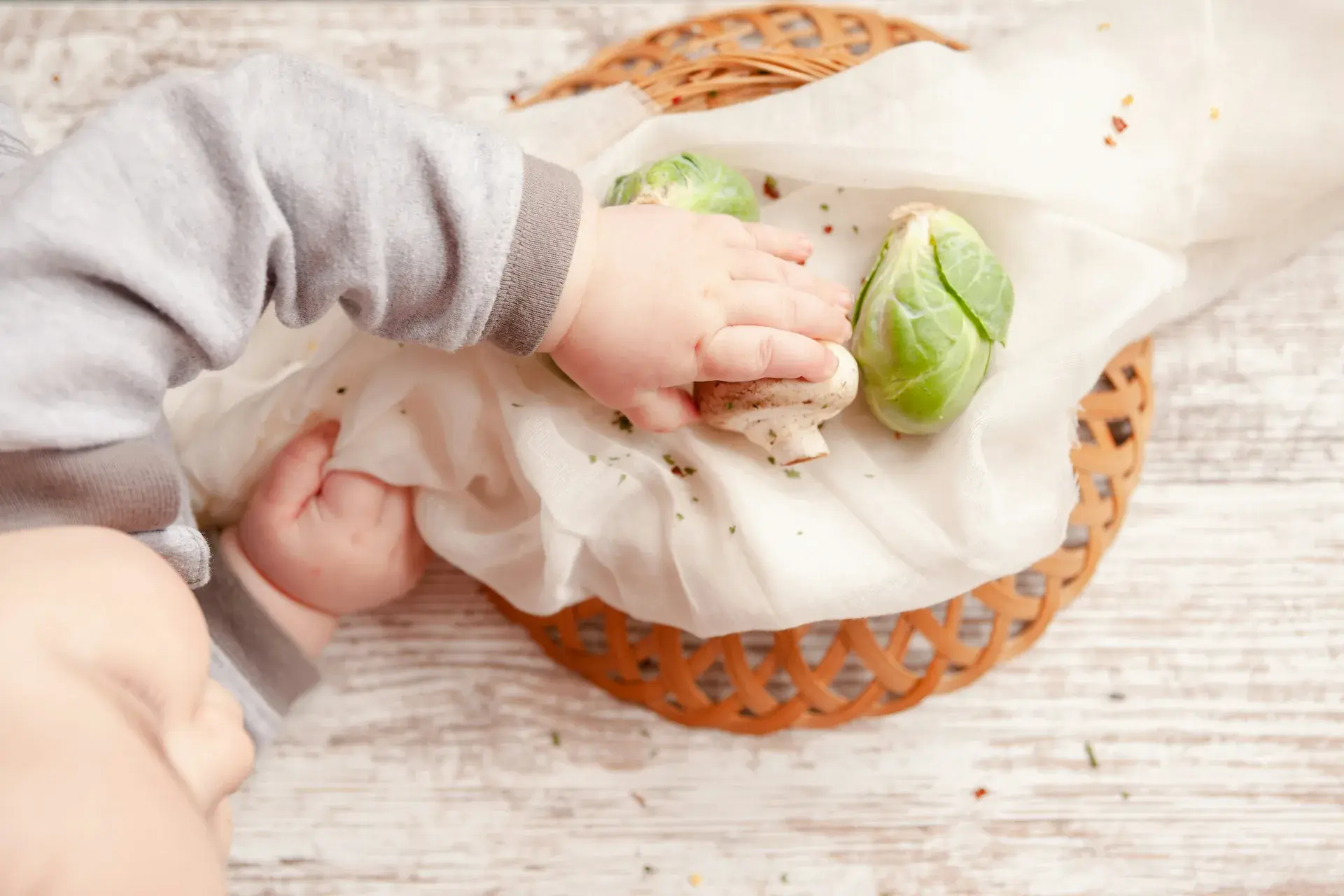
When you’re starting solids, it’s completely normal — and developmentally appropriate! — for your baby to play with more food than they eat.
Many parents imagine that starting solids means their baby will suddenly begin eating full meals. However, eating is a motor skill that takes time to develop — just like walking or drawing. Swallowing food is actually the last step of a long learning process! When you’re starting solids, it’s completely normal — and developmentally appropriate! — for your baby to play with more food than they eat. You may see them engaging their senses, like:
- Looking curiously at new food seeing
- Touching or squishing their food in different ways
- Smelling their food
- Tasting cautiously or eagerly
So if your baby plays with the food and more ends up on the floor than in their mouth, that is completely normal. It’s part of their learning!
My baby is ready to start solids… but I don’t feel ready.
Parent readiness matters, too ❤️ Parents set the emotional tone around food! You will never feel 100% ready, and that’s completely normal. But if you feel prepared enough to approach this stage with curiosity rather than stress, you are already doing a great job! Your main goal when starting solids is to create a relaxed environment where babies can explore.
Conclusion: Watch for readiness, instead of stressing about guidelines
Every baby develops at their own rhythm. Some babies are curious about food around 4 months. Others only show interest closer to 6 months or even later! Instead of focusing only on the calendar, the most helpful approach is to observe your baby:
- ✅ Do they have good neck control?
- ✅ Are they curious?
- ✅ Do they watch you eat?
- ✅ Are they bringing objects to their mouth?
Those small signs often tell us much more than any guideline. Starting solids at 4 months will not damage your baby’s gut microbiome or increase choking risk if it is done safely. And starting at 6 months will not automatically lead to picky eating or food allergies. What matters most is your baby’s developmental readiness.
Starting solids is not about doing everything perfectly! It is about exploration, connection, and gradually helping your baby discover the world of food.
If you'd like more support
Mélody is hosting a Starting Solids workshop in May. She'll cover:
- When and how to introduce foods
- Texture progression
- Allergen introduction
- Choking vs gagging
- Building a healthy food environment
You’ll meet other parents going through the same stage, which can be incredibly reassuring ❤️
📅 Next workshop: 2 May 2026
📍 Amsterdam 🔗 Reserve your spot